
 Sign In

Basic Maintenance: Tension & Skipped Stitches
We’ve all experienced some wacky things happening with our stitches. The thread will go all loopy or skipped stitches will mar that otherwise perfect topstitching. These are things that happen to everyone. These things shouldn’t keep us from enjoying the process of sewing. So here are a few common problems and solutions explained to help the next time something comes up.
(photo by iampeas)
Tension:
- Poor thread tension often comes from an incorrectly inserted needle. Machine needles have a flat side that should always face the back of the sewing machine.
- Check that the bobbin is wound correctly. It shouldn’t have any loose threads or loops sticking out. Never wind thread onto a bobbin that already contains thread, always use an empty bobbin.
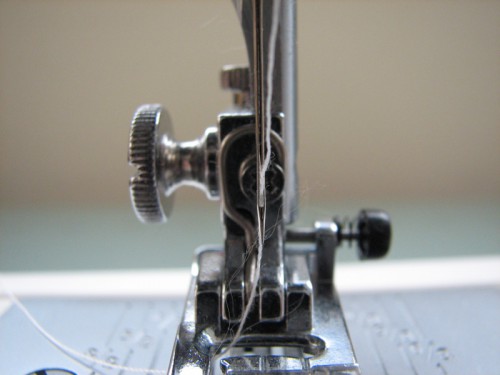
- Tension can be adjusted easily using the tension dial, but consult your sewing machine manual before doing so. The tension is too tight if the lower thread is pulled up to the top of the fabric. In which case, reduce the upper thread tension by adjusting to a lower number on the tension dial. For the opposite problem, when the upper thread is pulled too much to the underside of the fabric, the tension is too loose. Adjust the tension dial to a higher number.
(photo by L. Marie)
Skipped Stitches:
- Skipped stitches are symptomatic of several things, but a bent needle may be the culprit. When the stitches randomly start skipping, change your needle. If the stitches return to normal, then the problem was a bent needle. It can be caused by such things as tugging too hard on the fabric or the needle hitting a pin. Relax your hold on the fabric, and allow the feed dogs to pull it through.
- Make sure your machine is threaded correctly. Keep the pressure foot up every time you pull the thread through the machine.
- Another cause may be that the needle and thread are mismatched. Be sure to use the correct needle and thread for the job. When sewing knits use a ballpoint needle, and sharps for woven fabrics. Different weights of fabric need different size needles. Sometimes just changing the needle size will solve the problem.

Comments
Diana
June 2, 2011 #
Useful post, thank you. However, the part about the insertion of the needle doesn’t always hold. true, I have a old Singer, (a treadle machine actually–they’re the best!) and the flat side of the needle goes to the right, or the flat side of the foot shaft ( I think that’s what it’s called.) The position of the needle is also related to the position of the bobbin case. Sewers lucky enough to have a manual for their machine should be able to figure it out easily enough.
Liz
June 2, 2011 #
This is a great post. I recently had a tension problem that I spent way too much time trying to fix, only to find out that a lot of lint had collected in the bobbin area. Once I cleaned it, my machine ran fine. I won’t be lazy about that again!
Louise
June 2, 2011 #
I recently had a major problem with skipped stitches, I re threaded the machine numerous times, fiddled with the tension, used new needles etc etc etc and then tearing my hair out I googled the problem and eventually found that the needle was the wrong way round!!!! I never knew there was a front and back to the needle and over the years I had by accident always put the needle in the right way round. Now I know better! Thanks for these great articles.
One topic I wouldn’t mind seeing is how everyone manages their bobbins and thread reels, I’m forever trying to keep the right bobbin with with right reel. What do you do?
Wolf Baginski
October 14, 2013 #
One solution I have seen for keeping bobbins with the matched reel of thread is a plastic sort of double pin. One end fits the hole in the bobbin, the other the hole in the reel of thread. You might need a different box to have storage room for the sets. I’ve seen boxes with moulded pins for the reels, and if the reel is short enough, you could have reel and bobbin on the same pin and still close the lid.
Pam
January 7, 2014 #
I heard a great way to keep the bobbins with the spools. Use a golf tee! line the bobbin up on top of the spool and insert a golf tee to hold the two together :)
Kath
June 2, 2011 #
Excellent post – I’m always mystified by tension….
I also have an old Singer (201k) and she needs to have the needle inserted with the flat part to the left! As Diana noted, it’s usually in the handbook.
If you see your local sewing machine repair person, you might find that they have a copy which you can photocopy :) That’s what I did!
Gauss
June 3, 2011 #
Thank you for the post! I also have an old Singer, so the flat part of the needle goes… to the right! It is amazing how much of a difference that makes in the regularity of the stitches.
I don’t understand the part about only winding an empty bobbin. I usually wind on whatever bobbin has the least thread, but I rarely bother to empty a bobbin at the end of a sewing project. I’ve never had a problem…
Carrie
June 3, 2011 #
You mention needle size for different fabrics, could you tell us what needles are needed for what fabrics please. Thanks for your info. it’s wonderful!
Rebecca
June 3, 2011 #
I am curious, too…you referred to sharps & ballpoint. When would you use “Universal” needles?
Nikki
June 6, 2011 #
Sharp needles are used for having to cut into certain fabrics at the time of stitching, otherwise you would have a broken needle because maybe the fabric is otherwise too strong to penetrate. But if you used a sharp needle on a knit fabric, cutting knit would weaken it. So you would use a ball point needle so the needle would manuver smoothly through the fabric without damaging it.
Size of needles depend on fabric type, again, for example if you’re sewing a fine weave delicate fabric using a smaller sized needle will help you create a more solid stitch and stronger well held up garment.
Universal needles are used in everyday crafts or general home sewing. Making kitchen towels, a child’s smock, aprons, napkins, a quick garment of little importance, are examples of items you could use a “universal”/general needle.
Mae
January 18, 2013 #
THANK YOu!!! boy, i didn’t realize how LITTLE i knew about the different kinds of needles. I used a universal needle for all my sewing and had never even considered what the others were for, even though I OWN A TON OF DIFFERENT KINDS! that completely explains why my knits wear at the seams so easily and possibly could solve the problem I’m having now… my double needle keeps skipping stitches (but only with knits and not when I sew on woven fabrics) blah! driving me up the wall so I had to stop, regroup, and problem solve. Thanks again!
Laura
June 5, 2011 #
My worst tension problem ever was from loose feed dogs. Not only was the tension wonky, but it was tyng knots through the fabric. Another thing that can cause wonky tension and skipped stitches is thread caught in the machine. Both mine and my mom’s machine had a problem in which in one seam, it would change tension, stitch length, and skip stitches. We took them in to be serviced and complained about our problem. Our repair man had to half disassemble the machine to find thread wrapped around some of the works that was screwing up the machines. Nedless to say, we don’t have the problem anymore.
Trimble
April 24, 2012 #
I wonder if you’ve ever had trouble with a double needle dropping stitches. I recently had my machine worked on so it’s running well with the exception of when I use a brand new double needle on knits, it occasionally drops stitches from only the left needle. Have you ever had this problem?
Thanks!!
Jenni
June 20, 2012 #
This helped a lot. I recently changed my needle out and my machine started
Skipping stitches. Apparently I had put the needle in backwards. I turned it around and now my machine is working like a dream again.
erica
June 23, 2012 #
Trimble,
I have the exact same problem as you! I am a new sewer with a new Brother machine. Please post if you find the answer!
Thanks!
Trimble
June 24, 2012 #
Erica,
I still haven’t found the solution but will let you know if I do. Good luck finding it out too and if you do, please share!
Mary
August 17, 2012 #
One other important tip: make sure the needle is threaded.
I had a brand new Bernina serger (my favorite machine). Wasn’t picking up the right needle thread. Called the store…try this, called the store…try that, called the store…bring it down and we will look at it. Upon getting ready to pack it up I noticed that the right needle was not threaded. Granted the serger has a lot of threads to track, but… I have been sewing for 45 years and, seriously, did not want to make that call, but I decided that they should know why I “didn’t show up in 5 minutes.” We all had a good laugh, but seriously, geez. I am so glad I didn’t get all the way down there to find that out!
My serger also seems to not like dull needles, so if it skips, I change the needle…yes, and thread it!
Sylvia Taylor
February 6, 2013 #
Hello ~ My problem is the tension both upper and lower, I have tried many things adjusting the upper and lower tensions and using the tension for the type of fabric but the stitches are still coming out straight with just a tiny know between each stitch as if the stitches are not connecting at all the top looks the same as the bottom! I am working on a very delicate fabric and it is upsetting me because I will have to cut the fabric in half to eliminate the bad stitching job my machine create I should have waited for help as the material and medallions cost me almost $100.00 Do not want to damage this fine material any furthur so I am waiting for some answers and I do not want to pay 100.00 for repairs on my machine, So I decided to look on the internet first to see if I could fix it myself! I feel the automotive videos on Youtube are better then the ones for the sewing machines…does that make sense to you? I also want to know is there a particular way you place the thread through the bobbin? I it over or under? Do you understand what I mean? Thank you …I really would appreciate the help!
kris
March 31, 2013 #
Hi,
I bought my wife a Singer 4411 “heavy duty” sewing machine for Christmas and she is having loads of problems with skipped stitches when sewing through materials like denim. In this case she is using a denim needle with thread for denim but the machine skips stitches. She’ll sew a few inches fine and then the next couple of inches will be just one long section of no bottom thread being pulled up. She has regulated the tension, checked the needle is in correct, used different needles, used differnt threads, cleaned out the machine of all bits of thread, ironed the material before hand (sewing a double/triple layer for example) etc., and she is really at a loss. As the machine is almost new is it possible that it has a fault/needs some kind of regulation?
Thanks
Kris
Kay
July 25, 2013 #
i am having the SAME issues with my Singer h/d machine! i just finished a baby quilt for my new grandbaby & i used my singer for the whole project UNTIL i began to sew down the binding! started skipping stitches like crazy! i did all of the above, to no avail. i finally switched up to my Brother quilting machine & got that binding sewn down! this has happened on my Singer before, but only when sewing thru multiple layers or heavily interfaced items. i almost chucked it out the window before i recently finished a messenger bag. only on the final topstitching (several very firm layers) did it start skipping!! i wish someone would reply to your issue & maybe help me solve my problem in the process. at this point, i just thank goodness that i have my other machine for backup!
Sandy
September 14, 2013 #
Singer needles are a bit longer than universal- and while you mostly won’t have any trouble with universals– when sewing many layers you might try buying singer needles for yur singer
Brandi
November 20, 2013 #
Hey Kris,
My mother bought me the same machine and I love it! I am new to sewing and had the same issue until I loosened the bobbin tension a bit. (tiny yellow screw on front of bobbin case under metal plate) turn 1/4 turn lefty loosy and then play with top tension…Best advice with a new machine, you MUST get to know the “quirks” of your machine. BEFORE starting any project, get your stitch right on a test piece of material. Make sure to test sewing two layers etc if your project requires it. I also keep a little notebook to keep track of what settings, needles, etc work with what fabric. Saves me A LOT of time I would have spent troubleshooting and relearning. Hope this helps. There are a lot of great sewing apps for smartphones too. Best of luck to the wifey!
jenny
April 14, 2013 #
Hi , Please help…
I am a beginner sewer, I seem to be having trouble with dropping stitches or as I like to call it tread gathering up underneath when sewing . I thought it was the tension on the top of the bottom – but I have tested it and on some fabrics it works fine and other and in particular thin material. Does anyone know why or how I can stop this from happening. I just want to take up the hem on some trousers.
Thanks in advance sewing experts!
Debbie
May 15, 2013 #
Thank you SO MUCH for this information! Like many of the women commenting above I see that the tiny little needle can cause a good deal of problems. I even got my other sewing machine out thing it was the machine all together. Nope still skipping stitches. Well now I have a better understanding of why I’m loosing my mind when I set down to sew. Is there a chart with the needle size and type of fabric good to use. Have a good day and HAPPY SEWING ALL!
Michael
August 3, 2013 #
My wife has a brother sewing machine and gets tangled underneath when the bobbin is half empty put a full bobbin in and sews perfect
Marguerita
September 27, 2013 #
wow I’m a self-taught sewer and usually figure it out, but this has really helped me. Now I don’t have to beating my head against the machine before I get it right. Thank you for this site.
HooNew
October 17, 2013 #
Thank you, very helpful! The tension and bobbin problems are the reason I have never really liked to sew. My mom always had the same problem so I thought I had inherited it. Haha.
rose nelson
October 28, 2013 #
Schmetz has an app for the Iphone that tells you all about needles, what to use on what fabric, etc.
kateplieth
November 17, 2013 #
having a problem with an old singer and the needle keeps falling out. Singer 237 it has a needle clamp and then possibly a c shaped object which is part of the clamp? trying to figure this one out. I like to fix old machines and give thm to people who do not have a machine. I like to teach people how to sew. Addicts like company after all. And sewing is such an wonderfully healthy addiction. Thanks for any help.
Dave
December 13, 2013 #
Hi, I like working on machines as well. At some point I just ended up with a few and after getting them running, I started buying cheap beaters to repair and give away. I just got through with a 237 singer that I am going to adapt to a treadle and I looked at the needle clamp for you. Mine has just the needle clamp, but underneath it, it has a thread guide that is made of a spiral of wire, resembling a small spring. Is it possible that the “C” shape you mentioned could be the thread guide broke off at the first spiral turn? If it is, you could buy a new one, or maybe make one from piano or spring wire wound around a Q-tip stick to shape it. If that isn’t what you have , I would try it with out the “C” shaped piece as mine doesn’t have that and runs great. Hope This was some help to you.
Michelle
December 22, 2013 #
Thank you! I’ve been attempting to adjust my tension for over an hour due to skipping stitches and my needle was backwards the whole time. As soon as I switched it so the flat part was in back the issue was corrected immediately!! Thank you so much!
Kristin
January 15, 2014 #
Thanks so much. I called the sewing store and they kept insisting that my machine was broken. I kept insisting that it had worked just fine with a universal ball point needle and regular thread on cotton. Why would it not work on duck fabric with a heavy duty thread and a heavy duty sharp point needle? Maybe because I put the needle in backwards! LOL Thank you, Thank you, Thank you!!!!
jooles
March 22, 2014 #
i have had problems all day with skipped stitching on jersey knit with my brother innovis.. i just read on another site that layering the material between tissue then sewing and tearing away the tissue after could help… so thats my next move
Helen
May 16, 2014 #
I’m working with a two-way stretch jersey to create a sun visor….the inside frame is a layered with a heavy felt, buckram and diaper fabric…..I create a casing with the jersey and insert the inner layers….I’m not sure what needle to use..I’ve tried a universal 110, and a ball point heavy needle but my machine is not happy….keep getting a small “loop”, (no pattern)…randomly on the underside.
Any suggestions on how to correct this….the visor requires 7 rows of top stitching…very frustrating to have to remove each row
thanks
Alice Wilson
May 19, 2014 #
Thank you for the information. I was adjusting the bobbin and nothing changed. I turned the flat part of the needle to the right and adjusted the thread in the bobbin and now I’m cooking with gas. On my old machine it was to the back.
um Abdullah
June 17, 2014 #
I spent about an hour and a half trying to get the correct tension. Then I read your post and changed the position of the needle – the machine worked perfectly. Thank-you very much.